Office Relocation Company
Tell us about your office move and we will put you in touch with a removals firm that plans it, crates it and moves it.
Get a quote
What moves with you, and what doesn't
Most office moves are three jobs at once: the furniture and boxes, the IT, and the things you are leaving behind. Some firms do all three. Others pass the IT or the clearance to a specialist, so it's worth knowing which you need before anyone quotes.
 Office removalsSurvey, crates, packing, desks taken apart and rebuilt in the right place at the other end.IT relocationShutting down, labelling and reconnecting every desk, plus the comms cabinet or server room if you have one.
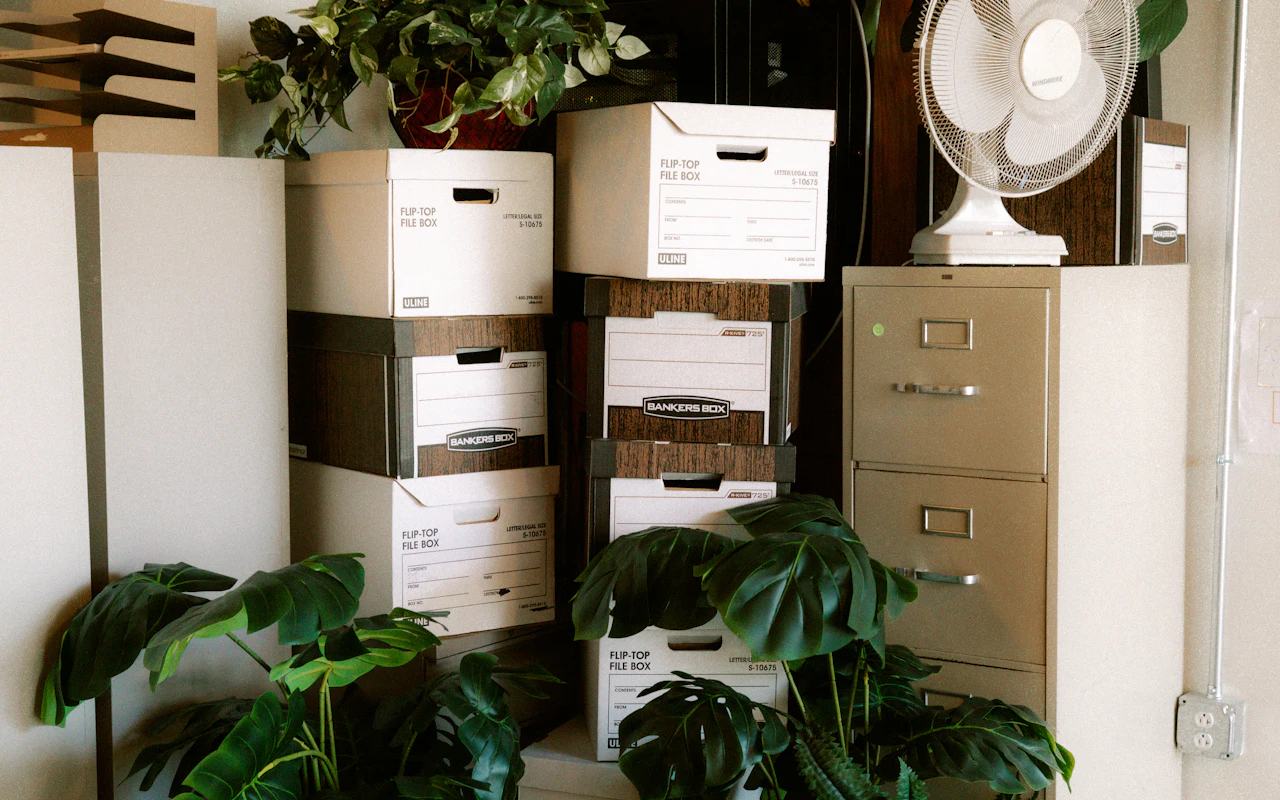 Office clearanceOld furniture, files and electricals taken away by people allowed to take them.£101 to £250per desk, as a typical range for a local move with desk IT. A guide, not a quote.Work out your move cost
How an office move usually runs
The move itself is often a single weekend. Everything around it takes far longer, and in a lot of cases the date is set by the lease rather than by anyone's diary.
Start with the leases. Your old lease decides when you must be out and what state the space must be left in. The new one decides when you can get in. If those two dates overlap by a week or two, the whole move gets easier.
Get the IT booked early. New lines and network work at the new office can take longer to arrange than the removal itself, so ask about it before you fix a move date.
The parts of a move that stay with you
A removals firm can carry almost everything. A few responsibilities stay with your business whoever you hire, and these are the ones people tend to find out about late.
Waste you hand over
Under the duty of care in section 34 of the Environmental Protection Act 1990, your business must only pass waste to someone authorised to take it. Anyone carrying it away should be a registered waste carrier, and you can check the public register yourself.
Data on old devices
Personal data on old PCs, phones and drives is still yours to protect under UK GDPR until it is wiped or destroyed. Ask for proof of wiping or destruction for every device that leaves.
The old lease
Leaving a leased office usually means repairs and reinstatement under the lease, often called dilapidations. Read the lease well before the move, not the week after. Our dilapidations guide explains how it works.
The new building
The responsible person for the new premises needs a fire risk assessment, and staff at new desks need workstation assessments under the display screen rules. Neither is the mover's job.
Moving in a city with a clean air or low emission zone? We have notes for London, Birmingham and Edinburgh.
Questions about moving office
What does an office relocation company actually do?
It plans and carries out the physical side of the move: a survey of the office, crates for staff to pack into, dismantling and rebuilding desks and storage, moving the IT, and clearing what you leave behind. BSI publishes a British Standard for this kind of work, BS 8522, which is a fair thing to ask a mover about.
How much should we budget?
For a local move with desk IT and two weeks of crate hire, a typical range is about £101 to £250 per desk, with a minimum charge on small moves. Weekends, longer distances and London cost more. Our cost calculator gives a range for your own numbers.
Can the move happen over a weekend?
Yes, and a lot of offices choose that so nobody loses a working day. Expect to pay more for weekend crews. If you can move in the week, ask for both prices and compare.
What happens to the furniture and computers we are not taking?
They count as business waste, so they can only go to someone authorised to take them, and old electricals have their own route under the WEEE Regulations 2013. Wipe or destroy any drives first. Our office clearance page goes through it.
Do we need to tell Companies House?
Only if your registered office address is changing. That is done online or on form AD01; GOV.UK explains how.
Where our information comes from
- Environmental Protection Act 1990, section 34 (legislation.gov.uk)
- Register as a waste carrier, broker or dealer in England (GOV.UK)
- The Waste Electrical and Electronic Equipment Regulations 2013 (legislation.gov.uk)
- Workplace fire safety: your responsibilities (GOV.UK)
- Working safely with display screen equipment (HSE)
- BS 8522, Furniture removal activities: commercial moving services (BSI)
- File changes to a company with Companies House (GOV.UK)
Tell us about the move
We find an office removals firm that works where you are moving and give you their name before any of your details go to them. It costs you nothing.
- You tell us where you are, what is moving and when.
- We look for a removals firm that covers the move and tell you who they are.
- Only if you agree do they get your details, survey the office and quote in writing.
Thank you. Your enquiry is with us.
We will contact you with the name of a removals firm that covers your move. They only receive your details if you tell us you are happy for them to, and the price you get comes from them, in writing.