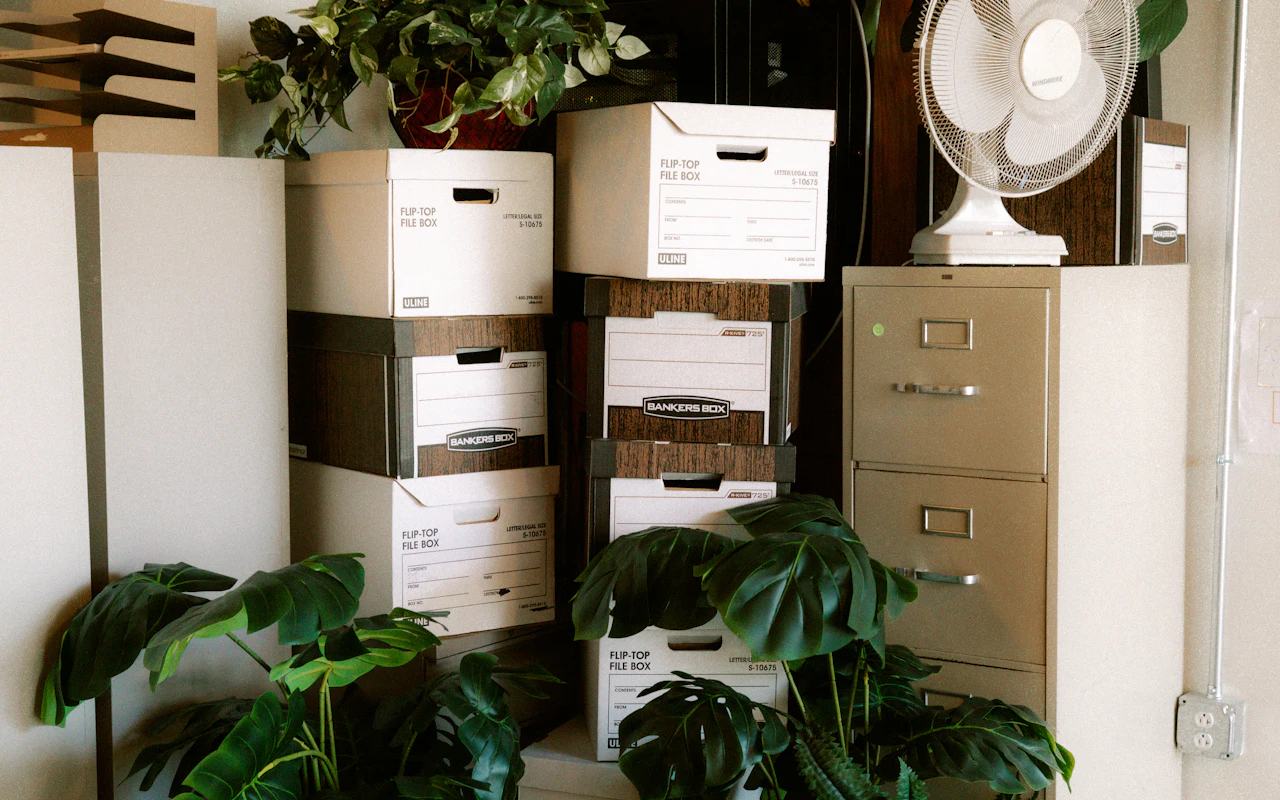
Office clearance
Clearing the office you are leaving is priced from a survey or an inventory, because no two offices leave the same things behind. What doesn't change is the law on who can take it.
Your waste is still your problem
It's easy to think that once a van has taken your old chairs away, the job is done. The law sees it differently. Under section 34 of the Environmental Protection Act 1990, a business that produces waste has a duty of care for it, which means handing it only to someone authorised to take it, and keeping a record of the transfer.
In other words, if a cheap "man with a van" fly-tips your desks, the question of who let them have it can come back to you. That's the main reason to check registration before anything leaves.
Sort it before anyone quotes
Clearance quotes vary a lot, mostly because offices differ in what they leave. Before you ask for prices, it helps to split what's left into a few groups:
- Reusable furniture. Desks, chairs and storage in good order can sometimes be resold or donated, which can bring the cost down.
- General waste. Broken furniture, partitions and everyday rubbish.
- Electricals. Computers, screens, phones, printers, fridges and kettles, which are WEEE and go to a separate route.
- Confidential paper. Old files that need secure shredding, not recycling bins.
- Data-bearing devices. Anything with a drive or memory, which must be wiped or destroyed.
A list like that, with photos, lets a firm give you a much firmer price than a guess from the doorway.
Electricals and data
Old IT is where most of the risk sits. The WEEE Regulations 2013 govern electrical waste, and business users are expected to use an authorised route rather than general waste. On top of that, personal data on old drives is still protected under UK GDPR until it is wiped or destroyed.
Ask the clearance firm how they handle data, and get a record listing each device and what happened to it. Our guide to disposing of old computers goes into more detail.
Leaving the space as the lease asks
Clearance often runs into the lease. If you have to strip out partitions or fittings to put the office back to its original state, check whether that is your job or the landlord's. In older buildings, work that disturbs the fabric can also raise asbestos questions, which the building's duty holder should be able to answer. See our dilapidations guide.
How a clearance usually goes
Inventory
You list or photograph what is going, split into reuse, waste, electricals and paper.
Survey and price
The firm checks access and volume and quotes in writing, including the data handling.
Clear
Items are removed, usually after the move, with reusable stock kept apart.
Paperwork
You receive transfer notes and data records to keep with your files.
Clearance questions
How much does an office clearance cost?
It depends on the volume, how much can be reused or resold, the electricals and any data destruction, and access. Clearance firms price from a survey or a photo inventory, so the most useful thing you can send them is a list of what is going.
Can our removals firm clear the office too?
Often, yes. Whoever takes your waste away must be a registered waste carrier, so ask for their registration number and check it on the public register.
What paperwork should we get?
A waste transfer note for the waste you hand over, which the duty of care expects you to keep, and a record of what happened to any data-bearing devices.
What counts as WEEE?
Waste electrical and electronic equipment: computers, screens, phones, printers, kitchen appliances and the like. It must not go in general waste. See NetRegs guidance for users of electrical equipment.
Is the rule different in Scotland or Wales?
The duty of care applies across Great Britain, but waste carriers register with Natural Resources Wales in Wales and with SEPA in Scotland, rather than the Environment Agency.
Where our information comes from
- Environmental Protection Act 1990, section 34 (legislation.gov.uk)
- Register as a waste carrier, broker or dealer in England (GOV.UK)
- Waste carrier, broker and dealer registration (NetRegs)
- Users of electrical and electronic equipment: what you must do (NetRegs)
- The Waste Electrical and Electronic Equipment Regulations 2013 (legislation.gov.uk)
- Asbestos (HSE)
Tell us about the move
We find an office removals firm that works where you are moving and give you their name before any of your details go to them. It costs you nothing.
- You tell us where you are, what is moving and when.
- We look for a removals firm that covers the move and tell you who they are.
- Only if you agree do they get your details, survey the office and quote in writing.
Thank you. Your enquiry is with us.
We will contact you with the name of a removals firm that covers your move. They only receive your details if you tell us you are happy for them to, and the price you get comes from them, in writing.